Best starting point: applied behavior analysis providers who connect treatment to your child’s needs and your family’s priorities. For your 2026 search, compare individualized goals, clinical oversight, respectful care, caregiver support, and practical fit rather than looking for one provider model that suits every child.
TL;DR
Compare applied behavior analysis providers by individualized goals, respectful care, clinical oversight, and family fit.
ABA Behavior Services offers New Jersey ABA therapy, parent training, and advocacy with BCBA-D ownership.
Ask how your child’s communication, preferences, comfort, and everyday routines shape treatment.
Treatment intensity, supervision, setting, and insurance requirements vary; discuss your child’s specific plan.
Why this matters
Choosing ABA therapy means choosing people who will work with your child and family. A useful comparison goes beyond a provider’s service list: it explores what goals matter, how decisions are made, and how the team responds when something needs to change.
ABA Behavior Services is an option for New Jersey families seeking individualized ABA therapy, parent training, and advocacy from a BCBA-D owned provider. You can learn about ABA Behavior Services while using the questions below to assess whether the services fit your family.
This 2026 guide ranks qualities to discuss, not named providers. The order helps organize your conversations; your child’s clinical needs, preferences, circumstances, and treatment plan should shape the final decision.
What makes applied behavior analysis providers worth considering?
Use these criteria before comparing appointment schedules or service descriptions:
Individualization: Goals connect to your child’s strengths, needs, and everyday life.
Clinical accountability: You understand who assesses needs, oversees care, and explains changes.
Respectful participation: The team discusses communication, preferences, comfort, and assent.
Family partnership: Caregiver support reflects your priorities, routines, and capacity.
Practical fit: Settings, communication, scheduling, and coverage arrangements support the proposed plan.
Meaningful review: Progress discussions address useful skills and quality of life, not just completed tasks.
No single credential, setting, or schedule answers all these questions. Look for explanations you understand, then ask how those explanations apply to your child.
Provider qualities at a glance
First
Quality: Individualized goals
Best for: Connecting treatment to daily life
What to ask about: How goals are selected with your family
Limitation to discuss: Goals can sound personal without being specific
Second
Quality: Clinical oversight
Best for: Understanding responsibility for care
What to ask about: Who oversees treatment and how support is determined
Limitation to discuss: A credential alone does not explain the oversight plan
Third
Quality: Respectful participation
Best for: Supporting communication and comfort
What to ask about: How preferences, assent, and distress inform sessions
Limitation to discuss: General statements need practical examples
Fourth
Quality: Caregiver partnership
Best for: Bringing support into family routines
What to ask about: How parent training fits your priorities
Limitation to discuss: Participation expectations need to fit family capacity
Fifth
Quality: Setting fit
Best for: Practicing skills where they matter
What to ask about: Why a setting suits the proposed goals
Limitation to discuss: One setting does not address every need
Sixth
Quality: Progress review
Best for: Understanding whether treatment remains useful
What to ask about: How progress and concerns lead to changes
Limitation to discuss: A summary score can leave everyday questions unanswered
Seventh
Quality: Clear coordination
Best for: Managing relationships and logistics
What to ask about: How updates, handoffs, and coverage questions are handled
Limitation to discuss: Processes depend on consent, staffing, and plan details
1. Individualized goals: best for connecting therapy to daily life
An individualized plan starts with understanding your child, not assigning a preset list of targets. Goals may address communication, play, social connection, daily living, independence, coping, flexibility, safety, or other meaningful skills. Reducing behavior that interferes with learning, safety, or quality of life may also be appropriate after assessment.
Strengths to look for:
Goals reflect your child’s strengths and your family’s priorities.
The clinician explains why each proposed goal matters.
Your child’s communication methods and preferences inform teaching.
Trade-offs to discuss:
A relevant goal still needs a clear definition of progress.
Family priorities and assessment findings may require discussion before goals are agreed upon.
For your 2026 consultation, bring 2 daily routines you would like help with. Describe what happens and what would make those moments easier, without needing to propose a treatment yourself.
Best for: Families who want therapy connected to meaningful everyday participation.
Verdict: Prioritize a clear connection between each goal and your child’s life.
2. Clinical oversight: best for understanding who guides treatment
Ask who assesses your child, develops the plan, oversees implementation, and discusses changes with you. A Board Certified Behavior Analyst, or BCBA, holds a professional certification; a BCBA-D holds that certification with a doctoral designation. The designation does not replace questions about the care your child will receive.
Strengths to look for:
Clear explanations of clinical roles and responsibilities.
An identified route for questions or concerns.
Oversight planned around the child and treatment needs.
Trade-offs to discuss:
Ownership credentials do not describe every clinician’s role.
Oversight arrangements vary by clinical need, treatment plan, setting, staffing, authorization, and payer requirements.
Ask, “How will clinical oversight work for my child, and what would prompt a change?” Avoid treating a particular weekly or monthly schedule as a universal measure of quality. The BACB’s Ethics Code for Behavior Analysts provides a professional reference for discussing ethical responsibilities during your 2026 search.
Best for: Families seeking clarity about clinical responsibility.
Verdict: Ask about the oversight plan, not just the credential.
3. Respectful participation: best for supporting communication and comfort
A provider conversation should make room for your child’s preferences, sensory needs, communication, and signs of comfort or distress. Ask how the team understands assent—your child’s expression of willingness to participate—and how that understanding informs care alongside consent and clinical responsibilities.
Strengths to look for:
Communication beyond spoken language is taken seriously.
Interests and preferences inform activities.
Clinicians explain how they respond to discomfort or reluctance.
Trade-offs to discuss:
Words such as child-centered need examples from practice.
Safety concerns and difficult learning situations can require individualized planning.
You might ask, “What would you do if my child turned away, asked for a break, or became upset?” The answer should help you understand the team’s approach, without promising that every session will feel easy. ABA is not a cure for autism; discuss goals that support your child rather than erase autistic identity.
Best for: Families evaluating how a provider approaches participation and dignity.
Verdict: Request concrete examples of respectful responses.
4. Caregiver partnership: best for support within family routines
Caregiver involvement can be an important part of helping children use skills across people, settings, and everyday routines. Parent training should be a conversation about your family’s needs and practical capacity, not an assumption that you can take on an unlimited therapy role.
Strengths to look for:
Space to discuss what feels manageable.
Explanations and practice tied to routines you identify.
Opportunities to ask questions without judgment.
Trade-offs to discuss:
Appointment times and practice expectations need planning.
Strategies may need adjustment for different caregivers or environments.
Ask how the provider would support a routine such as getting ready to leave home or asking for help. If emotional regulation is a priority, the guide to helping children build coping skills offers another topic to bring into that conversation.
ABA Behavior Services includes parent training among its services. Ask how that support would connect to your child’s proposed plan.
Best for: Families seeking practical collaboration rather than additional pressure.
Verdict: Look for caregiver support that fits your household.
5. Setting fit: best for practicing skills in relevant environments
Home, daycare, private school, and other settings offer different opportunities for assessment and teaching. The relevant question is how a proposed location supports your child’s goals, participation, and needs—not whether one setting is generally better.
Strengths to look for:
A clear reason for the recommended setting.
Discussion of privacy, distractions, and practical arrangements.
Planning for skills to be useful beyond the teaching activity.
Trade-offs to discuss:
Permission and coordination may be needed in shared settings.
Clinical suitability and insurance authorization can affect arrangements.
For in-home ABA therapy, ask how sessions would fit household routines. For daycare ABA therapy or private-school ABA therapy, ask how roles and communication would be agreed upon. ABA Behavior Services describes broad setting support; discuss which arrangements fit your child rather than assuming every setting is appropriate.
Best for: Families comparing where treatment could support meaningful goals.
Verdict: Match the setting to the purpose of treatment.
6. Progress review: best for understanding whether treatment remains useful
Progress discussions should help you understand what is changing and why it matters. Ask how the team combines treatment data, clinical observation, your child’s experience, and caregiver feedback when considering adjustments.
Strengths to look for:
Plain-language explanations of progress.
Discussion of skills outside structured practice.
A clear way to raise concerns about goals or methods.
Trade-offs to discuss:
Progress can differ across skills and settings.
A completed task does not, by itself, explain independence or everyday usefulness.
Try reviewing 1 proposed goal together. Ask what progress would look like, how it would be measured, and how the team would respond if the approach needed adjustment. Your 2026 provider comparison should leave room for honest discussion of uncertainty without promises about outcomes or treatment timelines.
Best for: Families who want understandable explanations of treatment decisions.
Verdict: Look for useful interpretation, not just a report.
7. Clear coordination: best for managing care and family logistics
A workable relationship includes knowing whom to contact, how information is shared, and what happens when arrangements change. Coordination with other professionals can also matter when it is relevant to the plan and supported by appropriate consent.
Strengths to look for:
Clear contact routes for clinical and administrative questions.
Explanations of therapist continuity and handoffs.
Willingness to discuss collaboration within professional roles.
Trade-offs to discuss:
Staffing and schedules can change.
Insurance benefits and authorization require plan-specific clarification.
Ask how the provider communicates about absences, therapist transitions, and questions from school or other care teams. For coverage, distinguish a provider’s explanation from your insurer’s benefit and authorization decisions. Confirm details for your own plan rather than relying on a general statement about ABA coverage in New Jersey.
Best for: Families balancing treatment with other care, school, and work responsibilities.
Verdict: Clarify communication and logistics before committing to arrangements.
How to use this ranking
The ranking begins with treatment purpose, then moves through clinical responsibility, participation, family support, setting, review, and coordination. These qualities overlap. A convenient location does not answer questions about goals, and a well-explained assessment does not settle scheduling concerns.
Use 3 questions to summarize each provider conversation:
What would this provider need to understand about my child?
How would the proposed care connect to our priorities?
What do we still need clarified before deciding?
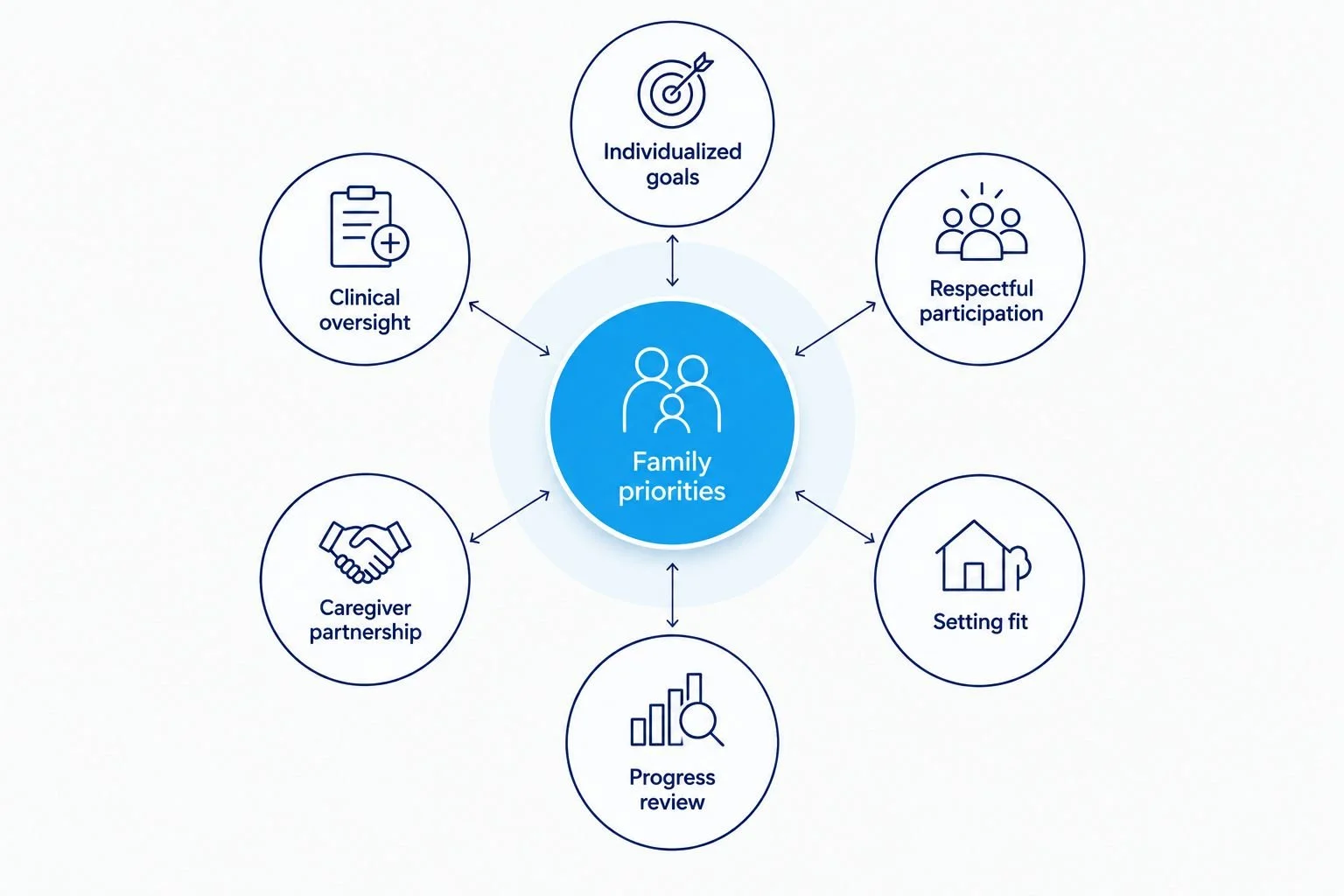
Use your family’s priorities to connect the different parts of a provider conversation.
Which provider should your family choose?
Start with the provider who can explain a thoughtful fit between your child’s needs, your priorities, and the proposed care. You do not need identical answers from every provider. You need enough clarity to understand the recommendation and ask informed follow-up questions.
For a 2026 search in New Jersey, ABA Behavior Services offers individualized ABA therapy, parent training, and advocacy with BCBA-D ownership. Ask how assessment, clinical oversight, setting options, and caregiver collaboration would work for your family before deciding.
Discuss your family’s needs
Learn about individualized ABA therapy, parent training, and advocacy in New Jersey.
FAQ
What should I look for in applied behavior analysis providers?
Look for individualized goals, clear clinical responsibility, respectful participation, caregiver collaboration, and understandable progress reviews. Ask each provider to explain how these would apply to your child rather than relying on general service descriptions.
Is a BCBA-D owned provider better for every child?
BCBA-D ownership is a qualification to consider, not a guarantee of fit or outcomes. Ask who will assess your child, oversee care, and communicate with your family, regardless of the owner’s credential.
How often should a BCBA supervise my child’s ABA therapy?
Clinical oversight varies with the child’s needs, treatment plan, setting, staffing, authorization, and payer requirements. Ask the provider to explain the proposed arrangement and what would prompt an adjustment.
How many hours of ABA therapy should my child receive?
Recommended treatment intensity depends on an individualized assessment and clinical planning. Discuss the reasons for the proposed hours, your child’s participation and needs, family circumstances, and applicable insurance requirements.
Is in-home ABA therapy better than therapy at daycare or school?
The appropriate setting depends on your child’s goals, clinical needs, practical arrangements, and applicable authorization. Ask why a setting is recommended and how the team would coordinate with the people involved.
What should parent training involve?
Parent training should address relevant caregiver needs and the child’s treatment goals in a way the family can understand and discuss. Caregiver involvement can be an important part of helping children use skills across people, settings, and everyday routines.
Does ABA therapy aim to cure autism?
ABA therapy is not a cure for autism. Discuss meaningful goals such as communication, play, independence, coping, and safety, with attention to your child’s identity, preferences, and quality of life.
One last thing
Bring an example of something your child enjoys—not just something that is difficult. A favorite activity, a preferred way to communicate, or a moment of connection can help start a fuller conversation about your child’s strengths and what meaningful support would look like.